- Affiliate Marketing 2.0
- Posts
- Affiliate Marketing’s #1 Pain Point—What’s the Fix?
Affiliate Marketing’s #1 Pain Point—What’s the Fix?

Joshua Kennedy
September 09, 2024
Affiliate marketing is a conversion-obsessed industry with deep roots in demand-capture tactics. How can we maintain our “performance” and results-oriented nature while moving into demand-generation campaigns for our clients?

AM2.0 #6 Solving for the #1 Pain Point in Affiliate Marketing
I won't lie; the last few newsletter editions have been pretty “heady” 🤯
I have introduced the concepts of demand capture and demand generation and briefed on the transition from a demand capture to a demand generation strategy.
Essentially, the question that faces all affiliate agencies/managers is, once we have our affiliate relationships in place to capture all of the recurring consumer searches in our industry (SEO, Reddit, paid search, loyalty, etc.), how can we continue driving meaningful demand?
Death, taxes, and demand generation - they all come for us.
I.e., how do we reach consumers who don’t know our brand or want our product right now and turn them into consumers quickly?
Consistently? Predictably? Sustainably?
That client call is next week.
Whatcha gonna do, Ghostbusters?
Incrementality is the “Wrong” Question
Incrementality has been the hot-button topic in affiliate marketing for brands and agencies for years.
Are affiliate programs incremental?
Is this affiliate incremental?
Is the affiliate channel as a whole incremental?
I’m not saying you shouldn’t want incremental sales at all times; I’m saying it isn’t the core pain point in affiliate marketing, or e-commerce, for that matter.
You’re Incremental, Now What?
Commission Junction has gone to great lengths to “prove” incrementality of the affiliate channel as a “whole,” claiming that affiliate-referred shoppers spend 88% more than their control counterparts.

Let’s assume that CJ is correct about affiliate incrementality.
Let’s assume every darn publisher in your Commission Junction affiliate program is incremental as of today.
So, now what?
Measurement is Not a Growth Strategy
Incrementality testing is a proof of value, but it isn’t a forward-thinking growth strategy.
Incrementality is telling me about what is and what has happened, but it doesn’t give me a sufficient roadmap for where I should go.
In other words, incrementality provides insights into revenue, traffic, and customer acquisition in my affiliate program’s current state. But, it doesn’t give me a growth plan for where I want my affiliate program to go.
It’s like learning your current BMI (body mass index) and getting feedback from a personal trainer that your gym workouts have brought incremental fat loss over the past few months.
Great, thanks, Einstein.
How many sets should I do?
What should I eat?
How much should I sleep?
What days should I go?
Even with “incrementality” learnings, a growth plan would still need to be implemented; budgets would need to be shuffled, new creatives would need to be created, more ad spending would be required, etc.
You need a plan, Stan.
And what you got you here won’t get you where you want to go.
Demand Generation is the “Right” Question
If we accept affiliate marketing’s incremental value, we’ll still need to tackle the challenge of demand generation.
Publisher Examples & The Demand Generation Elephant
Let’s say I have the following publisher types in my CJ affiliate program, and they have all been proven to be incremental:
Content/Blogs/Premium (incremental)
Paid Search (incremental)
Loyalty (incremental)
Retargeting (incremental)
Coupons (incremental)
This is more valuable than knowing my affiliate program is incremental “on the whole,” for sure.
At least I could optimize and plan that way, but it’s still insufficient.
It’s time to acknowledge the “Demand Generation Elephant” with the pink party hat hanging out on the Santa Barbara beach.

Demand Generation is Harder than Demand Capture
You’re a grade-A affiliate manager who has recruited all incremental partners in the affiliate industry listed above.
Let’s focus on loyalty/cashback.
After onboarding Capital One, Topcashback, and the rest, you cannot invite any additional loyalty partners into the program.
What are your options in this situation to grow sales?
Raise commissions for existing partners for “additional placements.”
Pay for placements in hopes of reaching a new audience.
Increase cashback to encourage more sales.
Are those options going to “move the needle” meaningfully and consistently?
Or are those band-aids and temporary solutions to try to show some progress to your higher-ups and clients?
Similar cases can be made about other publisher types like coupons, SEO reviews, and paid search affiliates.
Each of those partners has a severe case of diminishing returns.
Once you’re present with all of those publisher types, you'll encounter a glass ceiling based on the consumer search intent in your industry.
Levanta Client Example
I’ve been working with a client on Levanta for a few months, and we’re facing this challenge right now.
The Levanta affiliate network is a great case study for “demand capture & generation” because it heavily favors demand capture affiliates in the form of paid search publishers like Buyer’s Report.
In this program, 90%+ of the sales come from paid search publishers.
But again, we hit a glass ceiling with these publishers for a few reasons:
They only have so many review pages.
They only have so many terms they are bidding on.
They pretty much have a fixed budget for buying traffic.
They are limited by the consumer search demand for terms like “best supplement,” etc.

Challenges for Demand Generation
When I say “demand generation is more challenging than demand capture,” here’s what I mean.
Lower Purchase Intent
Demand capture is all about engaging the customers who are already searching for your brand or products.
Demand generation is all about converting cold, non-searching audiences into purchasers.
That’s a much more difficult proposition.
Price of Traffic
Demand-generation affiliate partners and campaigns are usually more costly than demand capture.
Brands place an immense value on reaching net new customers, even more so if they had zero prior search intent.
Brands are willing to pay a premium for these customers.
Typically, this means having to “reach” into or “pay for access” to a third-party-owned audience.
For example, that could be an influencer, social media platform, employee benefits network, or premium publication.
This traffic often comes with gated flat fees, cost per click, impression, and lead.

Audience Targeting Challenges
Demand generation campaigns are also challenging because you work with less relevant audiences.
A cold customer prospect who doesn’t know about your brand/product and isn’t seeking a solution can never be as relevant as someone actively searching for a solution.
The natural result of lower relevancy is lower conversion rates.
Buyer’s Report (demand capture) converts at 7.3% for my Levanta program.
A demand-generation partner would be expected to convert at a much lower clip.
Sure, you can spend on a flat fee campaign with a premium publisher or an influencer you feel is aligned with your target audience, but that is more speculation than guarantee.
Timing
You can reach the right people at the wrong time.
That sounds like a “Jerry Maguire” quote - am I dating myself (1992 baby)?
I’m just a boy looking at a… computer screen…
Demand-generation campaigns are more on the “awareness” side of marketing tactics.
They are efforts to help a brand reach potential consumers who have not shown purchase intent yet.
When that yet is, is unknown.
That means treading into uncertain waters with your client’s budget and ad spend 😰
Accessibility
In general, there are accessibility challenges for third-party audiences.
Even if you “pay” for campaigns, there can be a lag time before the campaign begins.
For instance, this could be an influencer post or brand review at a premium publisher.
Spotty Performance / Not Programmatic
Demand-generation campaigns tend to be more short-term in nature.
For example, a brand may negotiate several posts with an influencer, or a publisher may sell a series of brand-dedicated posts.
These are very transactional examples, where buying x gets you y.
Turn on and off. Begin and end.
Now, these transactional campaigns may be successful from a return perspective and worth re-investing.
But, the performance will ~shut off~ once the campaign ends, meaning off and on performance.
How Should We Approach Demand Generation Campaigns?
Why is Demand Generation Important?
Demand Gen is essential for two primary reasons.
Bigger Audience
The majority of consumers are not looking to buy right now.
Unless you’re working with an enterprise brand, most consumers don’t even know about your brand.
Therefore, the audience that isn’t currently seeking a solution and doesn’t know your brand represents the potential growth opportunity.
You Can’t Sustain Demand Capture Growth
The other primary reason is that you can’t sustain growth by working exclusively with demand-capture affiliates like paid search, SEO, loyalty, and retargeting.
That’s where the glass ceiling comes into play.
There are only so many consumers showing intent every month.
Only so many “pieces of content” and affiliates are targeted at reaching these researching consumers.
Optimizing Demand Generation Campaigns
If we take the various “challenges” present in demand generation, we can use them as a blueprint for optimization.
Challenge: 1) Low Intent 2) Traffic cost 3) Targeting challenges 4) Timing 5) Accessibility 6) Spotty performance | Possible Solution: 1) Maximize relevancy and intent. 2) Focus on low CPC, impression, or CPA traffic… or optimize conversions. 3) Leverage technology to target more accurately 4) See number 3 5) Optimize “pay to play” campaigns; focus on large audiences 6) Leverage pay-to-play ad buying to stabilize investment and returns. |
All Roads Lead Toward Algorithms
Our industry favors PR and content as the optimal “demand generation” partner types.
Our industry values “premium” content more than any other placements.
I'm afraid I have to disagree.
I think programmatic ad buying is the solution to our demand generation woes.
Meta, TikTok, and Co. - they’re your affiliate friends.
Meta Ad Network
Behind Google, Meta is the largest ad network in the world.
Unlike Google Ads and Microsoft Bing, which primarily serve ads based on “search intent,” ad networks like Meta (and TikTok, YouTube, Snapchat, etc) serve ads based on interests, behavior, and many other factors outside of “search intent.”
Google is where you go to search for something (demand).
Meta is where you go to hang out (demand gen).
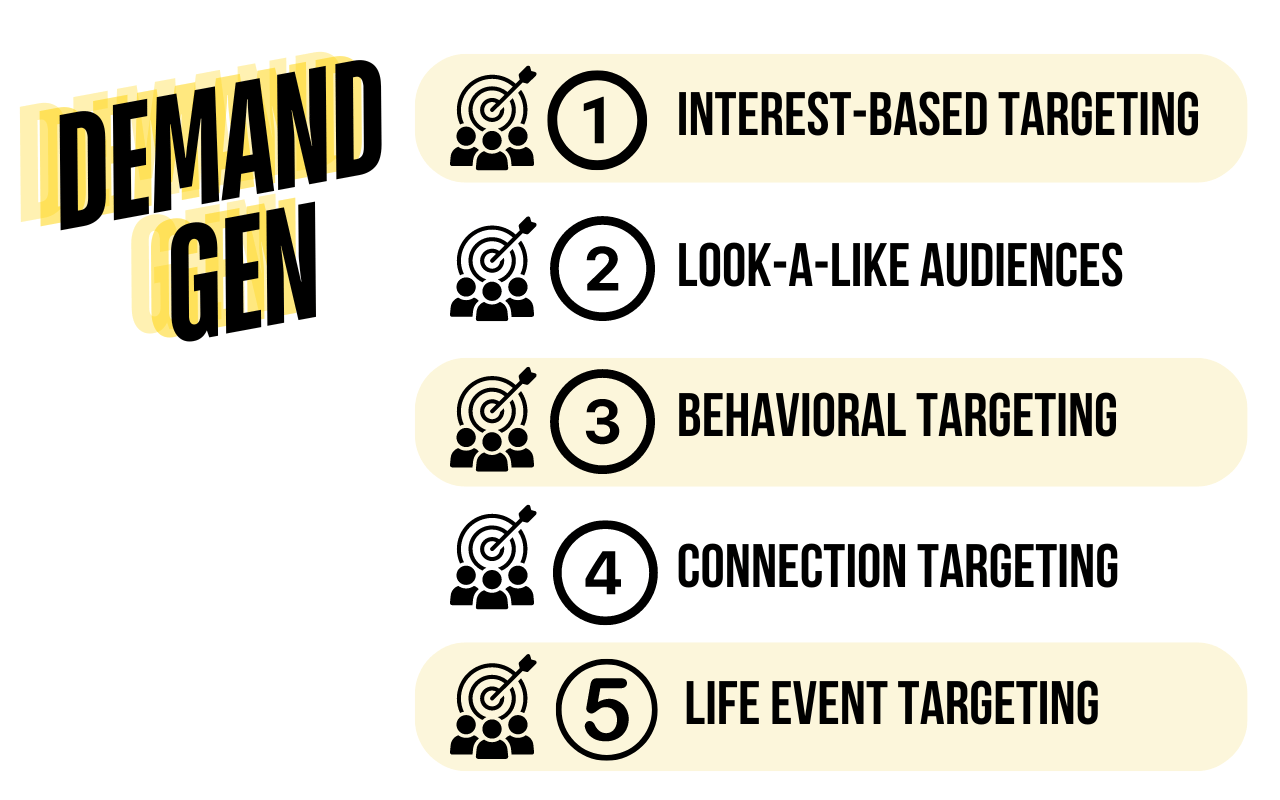
Interest-based and Behavioral Targeting
Interest-based targeting is the first targeting method with demand generation credentials on Meta (and other social media platforms.
Data Collection:
Meta gathers data from a user’s activity on the platform from what pages and posts they engage with, the types of content they share or comment on, advertisements they interact with, and websites they visit.
Interest Categories:
Based on that data, users are then grouped into various interest categories.
Targeting:
Advertisers can then select these interest categories to target a relevant demographic.
They can also drill down into more specific interests.
Lookalike Targeting
Lookalike targeting is another targeting method that can be used for demand generation.
Source Audience:
You start with a source audience that can include people who have visited your website, interacted with an app, or are existing customers.
Meta then analyzes this source audience based on behaviors, demographics, and interests.
Finds Similar Users:
Meta’s algorithm then identifies people who share characteristics with the source audience you provided.
This audience is called the lookalike audience.
Advertisers (your client) can choose a percentage size to control how closely this audience resembles your source audience.
A 1% audience would be more similar than a 10% percentage.
Other parameters like geographic location or behaviors can help refine the audience further.
Connection Targeting
In connection targeting, you can reach new users who are friends with those already connected to your page.
Life Event Targeting
Using Meta’s algorithm, you can also target audiences through life events like:
Anniversaries
Birthdays
New relationship statuses
Moving/relocating
New job
Graduations
Expecting / New parents
Now, it doesn’t have to be “Meta” that you leverage for demand generation.
Maybe YouTube or Snapchat are your go-tos.
The platforms will have similar targeting capabilities.
Demand Gen Targeting & Closing Thoughts
In algorithms, we trust.
In my view, the way to consistently and sustainably drive new demand (demand generation) is to leverage social media algorithms.
A steady return from a single paid social campaign can be a demand-generation lifeline and buy you time for other demand-generation campaigns, such as influencer and PR.
The goal is to leverage some of the targeting techniques in this newsletter and optimize the conversion funnels for the traffic you are targeting.
Then, you can play with targeting, expand budgets, or even move into other social channels.
To be clear, I am advocating for “affiliate paid social campaigns” using third-party affiliates, not brand ad accounts.
✌🏼
/
/